
Systemic Training Gap #2: Process Validation Life Cycle Training

A completed validation report alone does not establish that a process will remain in control throughout commercial manufacturing. We analyzed a broad set of FDA current good manufacturing practice (cGMP) Warning Letters and identified five systemic training gaps that repeat across pharmaceutical and biologics manufacturers, and validation throughout the product life cycle is one of the most persistent.
What Our FDA Warning Letter Review Reveals About Validation Programs
Continued process verification provides ongoing assurance that a process stays in control throughout routine commercial production, extending validation life cycle management through a product's full commercial life. Our review of FDA Warning Letters points to three recurring patterns behind the breakdown of that assurance.
1. Process Validation Studies That Don't Reflect Commercial Conditions
The FDA expects process qualification studies to reflect intended commercial manufacturing conditions and provide sufficient evidence that the process can reproducibly deliver products that meet their predetermined quality attributes. In a May 19, 2025, Warning Letter to an OTC drug manufacturer, CTK OTC Laboratories LLC, the FDA's investigators found that the firm could not provide blend uniformity studies to demonstrate its mixing process produced a uniform, homogeneous product. They cited the lack of process validation as a likely contributing factor to the batch's out-of-specification (OOS) results.
At the pharmaceutical quality system (PQS) level, this finding shows how a process can remain unchallenged even after an OOS result is produced. Without blend uniformity (BU) data, an OOS batch provides evidence about both the process and the product, and it may signal that a state of control was never established. Training may be one contributing factor when reviewers learn the mechanics of an OOS investigation but not how to trace a result back to the validation record that was meant to predict it.
That gap in pharmaceutical process validation, and the training implications that follow, is why CfPIE's Process Validation for Drugs and Biologics course dedicates focused time to building the case for representative, worst-case study design rather than best-case testing conditions.
2. Cleaning Validation and Equipment Qualification Without Scientific Rationale
Strong cleaning validation rests on documented scientific rationale covering product and soil selection, sampling locations, recovery, and acceptance limits that hold up to scrutiny. In a March 5, 2025, Warning Letter to an API manufacturer, Aspen Biopharma Labs Private Limited, the FDA cited inadequate cleaning validation, observed residue on equipment labeled "Cleaned," and required the company to implement remediation measures addressing worst-case products, difficult-to-clean sampling locations, and maximum hold times.
The same letter found that the firm had not adequately qualified the equipment used for commercial manufacturing because its validation studies relied on smaller development-scale equipment rather than the equipment actually used in production.
These findings suggest that the evidence supporting equipment qualification may not have been tested against the commercial equipment it was meant to represent. Scale-up and technology transfer add complexity here because equipment design, product-contact surfaces, and batch size can all affect whether development data remain applicable. Training may help when the personnel who author and approve qualification protocols learn to evaluate that applicability, not only to execute the protocol.
Cleaning validation training and laboratory equipment validation and qualification training can help address both gaps. Participants practice building a scientific rationale for worst-case product and soil selection, sampling locations, and acceptance limits before the FDA asks for one, and they learn to treat qualification as an ongoing obligation instead of a one-time exercise at commissioning.
3. Analytical Methods Used Without Proper Validation
Methods used daily for release testing sometimes lack a formal validation record, and legacy methods can be applied beyond their validated scope. In an August 6, 2026, Warning Letter to another API manufacturer, Tianjin Kilo Pharmaceutical Sci-tech Co., Ltd., the FDA found the firm had failed to perform test method validation for each test method used on drugs distributed to the United States, leaving inadequate assurance that the methods were suitable for their intended use and that the resulting data reliably reflected product quality.
Process-validation conclusions are only as reliable as the analytical methods used to generate the supporting data. This finding can point to a quality unit responsibility as much as a lab failure, since it suggests the methods generating release data were never confirmed suitable for their intended use before being relied upon.
Analytical method validation training addresses this directly, giving lab personnel and quality reviewers the grounding needed to confirm that a method is suitable for its intended use or to verify it against compendial standards before it's relied on for release decisions.
Core Practices for Effective Validation Life Cycle Management
Organizations can manage validation more consistently by building these practices into their programs:
- Treat validation as a life cycle: Development knowledge, qualification, monitoring, change control, and periodic review are connected as a single program rather than separate events.
- Apply quality risk management: Risk-based prioritization identifies critical variables and directs resources where they create the most impact. Training in Quality by Design and Design of Experiments reinforces this risk management approach.
- Involve process owners and experts: Validation reflects real operating conditions when the people who run the process help design and review it.
- Establish clear ownership after approval: Operations and engineering, alongside the validation team, maintain the validated state once a report is signed.
- Integrate ongoing data into verification: Process data, deviations, complaints, OOS and out-of-trend results, change controls, and corrective and preventive action (CAPA) effectiveness checks should inform continued process verification and management review.
- Assess cumulative change: Reviewers weigh the combined effect of multiple changes, building a fuller picture than would be possible by reviewing each in isolation.
- Train reviewers to challenge assumptions: Scientific and statistical reasoning gives reviewers the confidence to test whether assumptions, acceptance criteria, and conclusions still hold.
Building Validation Competency
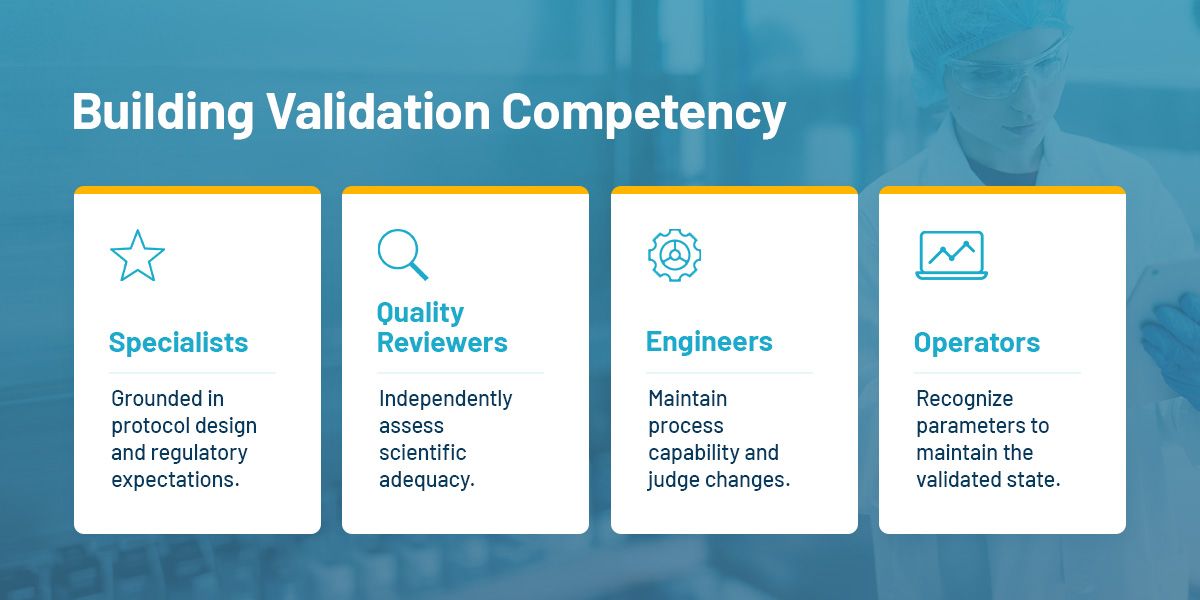
Validation training is most effective when it is role-based. Each function applies a different but complementary set of competencies to protect the validated state:
- Specialists benefit from a grounding in protocol design, statistics, sampling strategy, and the regulatory expectations for each validation type.
- Quality reviewers develop the ability to independently assess scientific adequacy by reasoning through assumptions and acceptance criteria.
- Engineers and process owners understand the evidence required to maintain process capability and judge which changes could affect the validated state.
- Operators gain confidence by learning to recognize the parameters and conditions required to maintain the validated state during routine manufacturing.
Training works best when it's tailored to an organization's products, equipment, and change history. This could include a scenario built around a real cleaning validation acceptance limit, an equipment qualification protocol for the organization's own filling line, or a stability study design for a specific product. Relevant training teaches reviewers to recognize when a new result calls a previous assumption into question.
While training builds awareness of a requirement, competency is demonstrated through consistent application. Rather than just reciting method validation parameters from memory, a specialist must be able to defend a validation protocol's acceptance criteria in response to a regulator's questions or detect a stability trend drifting toward an OOS result.
Organizations that close the gap between training and competency see results in practice. For example, change assessments catch shifts in equipment or raw materials before they affect the validated state; adverse trends are flagged and investigated rather than explained away; and study designs hold up because they were built to represent production accurately.
Strengthen Your Validation Program With the Center for Professional Innovation & Education (CfPIE)
Running a validation program that aligns with the FDA's expectations means building the cross-functional competency that turns event-based validation into true life cycle management. CfPIE has delivered life sciences training for more than 25 years and was awarded a five-year training contract by the FDA.
For validation specialists looking to formalize their expertise, the Certified Process Validation Professional (CPVP) credential offers a way to advance their careers while demonstrating that expertise to their organization and auditors.
The curriculum supporting the CPVP credential helps professionals develop the scientific and regulatory judgment needed to identify weak assumptions, evaluate validation evidence, and maintain a state of control. As a trusted provider of quality life science training, CfPIE draws on a robust catalog of on-site and public courses to help your team close these gaps before the next inspection.
For more targeted training, our Computer System Validation course covers the validation of systems that capture and manage process data, while Implementing an FDA Compliant Stability Program addresses building and defending a product's stability profile.
Call us at 610-708-2264 or email info@cfpie.com to talk through how we can support your program.

Blog Categories
Stay Informed