
5 Systemic Training Gaps That FDA Warning Letters Keep Revealing

An FDA Warning Letter marks a serious regulatory event for a life sciences manufacturer, but it also provides valuable insight into how the FDA evaluates quality-system performance. Warning Letters identify significant violations, explain why a company's response may be inadequate, and describe the scope of assessment, remediation, and supporting evidence the FDA expects.
These insights come with an important caveat: A single citation tells only part of the story. The deficiency identified in one department or process may reflect weaknesses elsewhere in the pharmaceutical quality system (PQS). Meaningful improvement, therefore, requires companies to look beyond the immediate observation and understand the organizational, scientific, and operational factors that allowed it to occur.
With the goal of identifying the interconnected weaknesses that continue to surface, we analyzed a broad set of recent FDA current good manufacturing practice (cGMP) Warning Letters. Our review included contract manufacturing and testing facilities, sterile and nonsterile operations, active pharmaceutical ingredient (API) manufacturers, finished-dose manufacturers, and over-the-counter (OTC) drug manufacturers operating in the United States and internationally.
The pattern was consistent: Similar quality-system weaknesses appeared repeatedly across companies, products, and geographic regions. Collectively, they point to gaps in applied competency that more effective training, supported by leadership, appropriate resources, and organizational accountability, can help address.
What Our Research Revealed
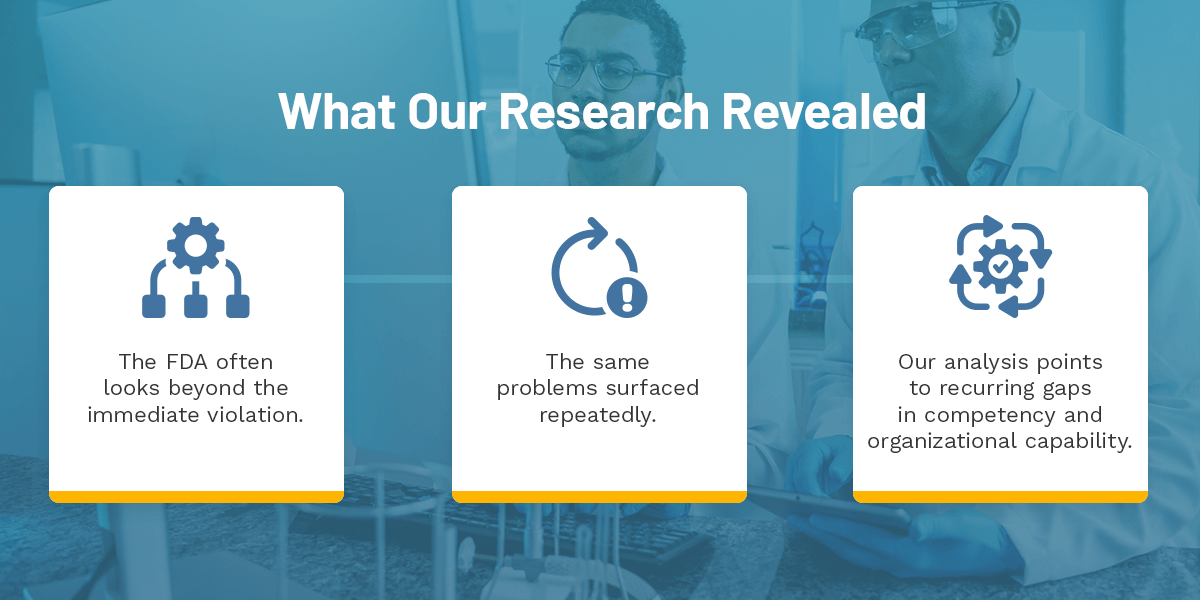
Three patterns stood out across the letters we reviewed:
- FDA frequently looks beyond the immediate violation. When a significant problem surfaced, the agency often required the company to determine whether it extended beyond the department, process, or site where it was initially identified. FDA also emphasized management's responsibility to ensure effective, sustainable remediation. This reflects the agency's continuing focus on whether the underlying quality system enables personnel to make scientifically sound, compliant decisions, not merely whether required procedures exist.
- The same problems surfaced repeatedly. Similar issues appeared across letters, regardless of company, product, or country. That repetition pointed to structural weaknesses and led us to ask: Why do these problems continue despite decades of regulatory guidance and increasingly sophisticated technology?
- Our analysis points to recurring gaps in competency and organizational capability. Employees may lack the applied knowledge, judgment, or cross-functional understanding needed for the PQS to function as intended. At the same time, leadership may not provide the authority, resources, or sustained oversight required to support effective performance. Practical, role-based training can help close these gaps, but only when it is reinforced through effective systems, management engagement, and evaluation of on-the-job performance.
The 5 Training Gaps We Identified
Based on the letters we reviewed, companies often have the right pieces in place on paper, but real-world performance still falls short. Here are the areas where training gaps showed up the most for
pharmaceutical and other life science companies:
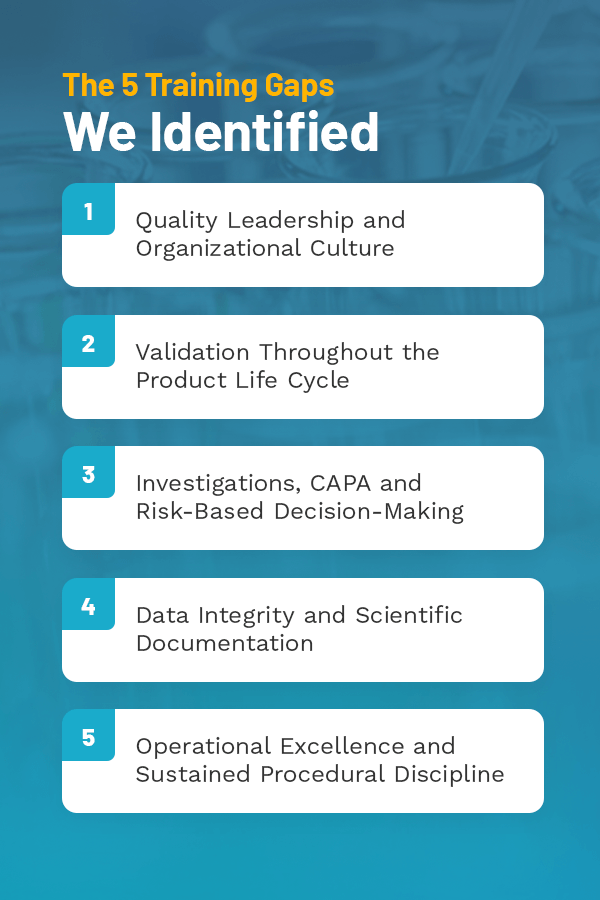
1. Quality Leadership and Organizational Culture
Warning Letters repeatedly described quality units that could not fulfill their responsibilities effectively. Common findings included failures to approve or reject materials appropriately, identify incomplete batch or laboratory data, and exercise sufficient authority and independence in making quality decisions. When deficiencies recurred, appeared across multiple sites, or persisted despite previous corrective actions, FDA often required executive management to assume greater responsibility for comprehensive, sustainable remediation.
[Read Our Deep Dive on Quality Leadership and Organizational Culture]
2. Validation Throughout the Product Life Cycle
Validation is sometimes treated as a one-time approval step rather than an ongoing responsibility. Process validation studies didn't always reflect real commercial conditions, and cleaning validation protocols sometimes lacked a clear scientific rationale. Our analysis also suggests a broader organizational risk: When validation expertise is concentrated within a small group of specialists, other personnel may not recognize when a change, deviation, or adverse trend warrants renewed scientific evaluation.
3. Investigations, CAPA, and Risk-Based Decision-Making
Our review found that investigations often stopped at an unsupported explanation, such as operator error, without examining the conditions that made the error possible. Investigations did not consistently determine whether similar problems had occurred elsewhere or review previous deviations and corrective and preventive actions (CAPAs) for broader patterns. Corrective actions frequently relied on procedure revisions and routine retraining without verifying that those measures developed the knowledge and judgment needed to prevent recurrence.
[Read Our Deep Dive on Investigations, CAPA, and Risk-Based Decision-Making]
4. Data Integrity and Scientific Documentation
Warning Letters described laboratory and manufacturing records that omitted unsuccessful or preliminary test results or were not documented contemporaneously. Shared credentials, excessive system privileges, and inadequate audit-trail review created opportunities for data to be changed without appropriate detection or review. In other cases, quality units confirmed that required records existed without adequately evaluating whether the underlying data were complete, attributable, consistent, and scientifically credible.
5. Operational Excellence and Sustained Procedural Discipline
Several letters described facilities where written procedures, previous CAPAs, or prior training already existed, yet actual practices continued to diverge from approved requirements. Deficiencies clustered around hands-on activities such as aseptic technique, equipment cleaning and maintenance, and production documentation. In some cases, procedures lacked sufficient specificity; in others, staff did not consistently follow established procedures. Initial qualification was also not always followed by reassessment when processes, equipment, risks, or job responsibilities changed.
From Training Gaps to Demonstrated Competency
A weakness in one area rarely remains contained because the elements of a PQS are interconnected. Incomplete documentation can undermine an investigation; a weak investigation can produce an ineffective CAPA; and an ineffective CAPA can allow the original problem to recur. Sustainable improvement, therefore, requires companies to address both the immediate deficiency and the related weaknesses throughout the system.
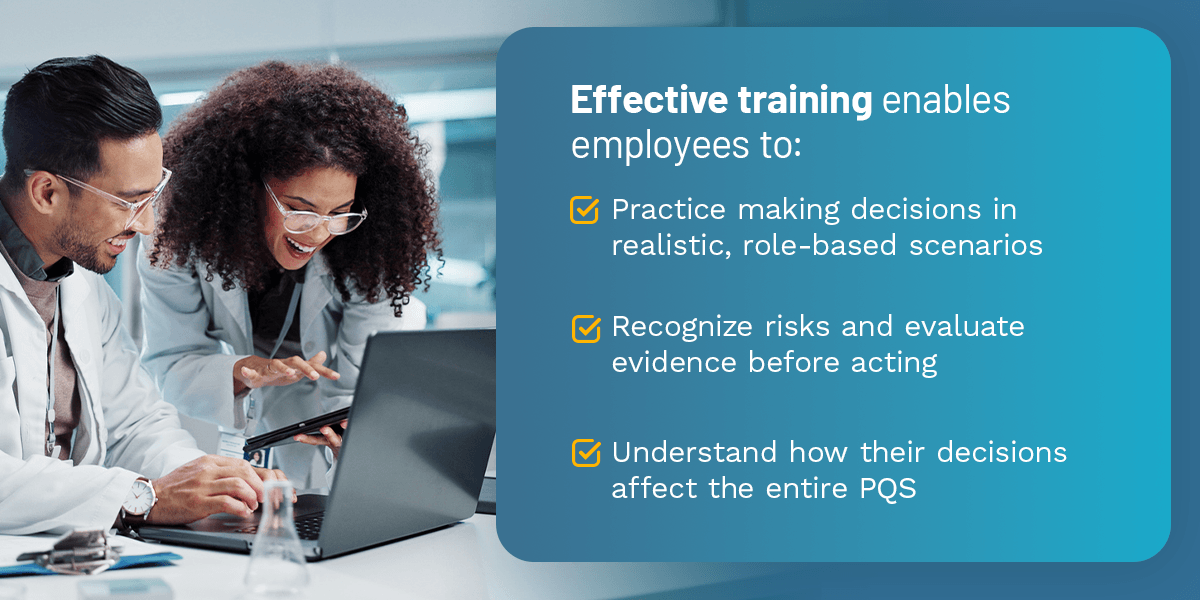
Sustainable improvement begins with people who understand how their roles affect the broader system and who can recognize risk, evaluate evidence, and make sound decisions. Training develops these capabilities when employees practice applying knowledge through realistic, role-based scenarios and understand how their decisions affect the entire PQS.
Companies should measure training effectiveness through demonstrated performance, not attendance or course completion alone. When well-designed training is reinforced by engaged leadership, appropriate resources, and effective quality systems, it can help an organization identify problems earlier, make better decisions, and reduce recurrence.
Where to Go From Here
Let CfPIE guide you toward a stronger PQS and more resilient quality culture through practical, expert-led training. For more than two decades, we've built our courses around helping life science companies close the gap between knowing a procedure and reliably executing it. Through our live instructor-led virtual classrooms and customized on-site programs, we support organizations in building capability at every level, from frontline operators to executive leadership.
Explore our course catalog to find the training that fits your organization's needs, or call us at 610-708-2264 to speak directly with our team.
Want to see our full methodology for reviewing the FDA's Warning Letters and complete findings? Download our entire white paper.

Blog Categories
Stay Informed